
12 Day 100-Hour Ayurveda Yoga Teacher Training in Rishikesh, India
Ayurveda Yoga Teacher Training India
This course is for seekers who wish to learn about Ayurveda, the historic system of medicine, and explore yoga in its most authentic and purest form. The 100-hour Ayurveda yoga course is a two-week long, complete immersion beginner course for individuals aspiring to step into the world of yoga, gain refined knowledge of Ayurveda, and begin their journey.
Meet the instructors
Highlights
- Daily yoga classes
- Certified yoga instructors
- Daily Ayurveda classes
- Daily mantra chanting, meditation, anatomy, and asana lab
- Outdoor excursions to caves, temples, waterfalls, or local mountain villages
- Certificate of completion
- 3 daily fresh organic vegetarian meals
- 11 nights accommodation
Skill level
- Beginner
- Intermediate
- Advanced
Yoga styles
10 days with instruction in English
Accommodation
Facilities
- Shopping
- Air-conditioned rooms
- Café
- Dining area
- Kitchen
- Lobby
- Restaurant
- Smoke-free property
- Yoga shala
- Yoga studio
- ATM / banking
- Convenience / grocery store
- Currency exchange
- Dry cleaning
- Free parking
- Free Wi-Fi
- Internet access
- Ironing / ironing board
- Laundry
- Library
- Medical assistance
- Wireless internet
During the course, you will be staying at Rishikesh Yogkulam. The school has yoga hall, a dining area, a reception and a wonderful area surrounded by mountains. Rishikesh Yogkulam offers single and double rooms based on the student’s requirements.
Every room has an attached bathroom with a western toilet and hot shower and a balcony with a mountain view(subjective). The rooms for the yogis are well-maintained and clean. They offer bed sheets, pillows, bath towels, toilet paper, a blanket, and welcome amenities upon arrival. Good Wi-Fi is included on every floor. Water and laundry service are also available.
The location of Rishikesh Yogkulam is incredibly central, offering the utmost convenience. All the necessary amenities like an organic store, ATM, bike rentals, and renowned cafes are in close proximity. Moreover, they are just a 5-minute walk away from the hanging bridge and the sacred River Ganga, allowing easy access to their spiritual essence and tranquility.
Program
What does this training give?
The 100-Hour Ayurveda Yoga Teacher Training in Rishikesh is a perfect course for someone who is passionate about the art of yoga and wants to take it up as a profession. This course will help you if you want to turn into an authorized teacher. It is a round course that helps you achieve fitness, flexibility, and peace of mind.
Furthermore, this course will teach you how to make decisions in contradictory situations in your profession as a teacher and act accordingly. This course prepares you for the future with its expert teaching body and intelligently curated structure. In this course, you will be challenged not only on the physical but also on a mental level and achieve expertise in both.
With this course, you will get to gain knowledge about the fundamental theories and histories of yoga and get to know about its various asanas. Additionally, you will be able to seek harmony of the body, and the mind and achieve balance with the surroundings. With this course, you will get an overall experience of asana control, diet needs, purity ceremonies, and many more things to become a successful yoga teacher.
Why take this training?
The 100-Hour Ayurveda Yoga Teacher Training in Rishikesh is a very innovative module that is designed to help the students gain the maximum skills with the use of theoretical, practical, hypothetical, and intuitive knowledge in a safe and protected environment. This course ensures that you learn the asanas to perfection and are prepared to become a professional.
It provides one-to-one teaching sessions to clarify doubts, boost confidence, and gain a wide understanding of the subject. This course is at par with the best international courses of yoga teachers programs and is a great opportunity for individuals who are passionate about yoga teaching.
Thus the 100-Hour Ayurveda Yoga Teacher Training in Rishikesh is a complete module that helps you get a grip on the Hatha Vinyasa Yoga standards and learn from the best. The module is designed to provide a complete experience and maximum benefit for the participants.
What are the highlights?
100-Hour Ayurveda yoga teacher training course outline
Yoga practice
- Daily yoga sessions
- Hatha and Ashtanga yoga practice
- Meditation and pranayama classes
The Philosophy of yoga
- In-depth study of Patanjali's Yoga Sutras
- History and overview of yoga
- Eight limbs of yoga
Anatomy
- Skeletal and muscular system of the body
- The Nervous system
- Postural knowledge and injury avoidance
Yoga sequencing
- Balancing of energy
- Discovering self-practice routine
Yoga teaching skills
- Be a confident teacher by improving your teaching abilities
- Discovering your own style of teaching
Ethics and business
- How to sequence your class
- How to give instructions
Course highlights
- Teacher training for 100 hours: Get the teacher training manual on arrival
- 11 days on location: Explore Rishikesh, the soul of yoga
- Yoga teacher certification
- All-inclusive packages
- Over a decade of experience: 12+ years of experience and excellence in yoga
- Classes with more focus: Each class with a group of maximum 15-20 students
Amenities upon arrival
- Water bottle
- Welcome drink
- Refreshing towel
- Toilet paper
100-hour yoga teacher training program
As a yogi, Rishikesh Yogkulam understands that the learning pace depends on an individual’s body type and is distinct for all. They do not believe in rushing through the training of any of their students. Hence, they present to you an option to take up the first 100-hour yoga teacher training in Rishikesh, India out of your 200-hour training in two different sections.
During the opening (welcoming) ceremony, you will be provided with a complete yoga kit which includes a yoga mat, books for study, notebook, water bottle, neti-pot, rubber neti, school t-shirt, and rudraksha mala.
Rishikesh Yogkulam has made their 100-hour yoga teacher training course in such a unique way so it's suitable for all the different levels of students as it includes yoga for beginners, primary series, intermediate series, and advanced level.
Every single student in the class will get personal attention from the individual teachers as all the yoga gurus are highly qualified, experienced holders, and well-known names in India. This 100-hour yoga teacher training course is for those who would like to deepen their practice, for new learners, and for beginners.
It is for those who would like to deepen their knowledge and practice in different aspects of yoga, anatomy, Ayurvedic therapies, and yogic life. During the course, you will assimilate not only the main subject of yoga but also learn the principles of yogic philosophy which will put you on the right path.
You will expand in the world of yoga, develop spiritually and physically, and improve your knowledge, professional skills, and the ability to teach yoga in your specific way. You will have special classes to understand the nuances of class teachings based on yogic principles and discussions on philosophical topics that will help streamline the approach and experiences of yogic practices in the class.
Apart from teaching the technical aspects of class teaching, very interactive and vibrant discussions on various aspects of the yogic lifestyle and ethics of yoga teachers will be encouraged. There will be sessions of talk and interactive discussions on different aspects of class teaching and presentation.
The dedicated and experienced panel of yoga teachers and gurus at Rishikesh Yogkulam have immense knowledge of Vinyasa yoga flows, Vinyasa yoga poses, different kinds of yoga, Ashtanga yoga, Hatha yoga, meditation, and much more. Following a unique way of making seekers learn, providing full attention to the needs of people personally as well as professionally. The staff is highly cooperative and ensures to make your stay as convenient as possible.
Ayurveda
- Introduction to Ayurveda
- Definition of Ayurveda and its unique features
- Concept of health according to Ayurveda
- Aim of Ayurveda
- History of Ayurveda
- Pancha Mahabhuta concept (5 body elements)
- Tridosha concept
- Concept of body, mind, and soul
- Concept of Sapta Dhatu (7 body tissue)
- Concept of Mala (waste products)
- Concept of Agni (digestive fire)
- Concept of Prakriti (body constitution)
- Panchakarma therapy (detoxification)
- Marma (vital energy points)
- Ayurvedic diet concepts
- Ayurvedic home remedies
1. Recitation of sacred sound (mantra chanting)
The purpose of mantra chanting in yoga is to generate vibrations and connect with the universe. Each mantra is special and rich with spiritual energy.
- Om asato maa sadgamaya (Mantra from Upanishad)
- Tvameva mata ca pita tvameva (Sloka on gods)
- Om tryambakam yajamahe (Mantra on lord shiva)
- Om sahana vavatu (Mantra from Upanishad)
- Guru brahma guru vishnu Gurudevo maheshwara (Guru stotram)
- Yogena cittasya (Sloka on sage Patanjali)
- Hare Rama, hare Krishna (Maha mantra)
2. Yoga postures (asana)
Students will gain extensive knowledge of yoga postures and will increase their strength, flexibility, and discipline.
Hatha yoga
This is the traditional form of yoga that helps to control the mind and body through various holistic techniques. This type of yoga involves performing poses that are slow or medium and require the individual to hold the pose for a long time. It helps you to prepare for deep meditation helps to improve your health and increases happy thoughts.
Hatha in Sanskrit means pressure or forceful. That's why hatha yoga means such a yoga posture in which physical force and physical pressure are applied. It can be understood in this way, the yoga in which there is a balance of both body and mind is called hatha yoga. Under this yoga style, pranayama breathing, chanting, and yoga poses done with hands are called mudras. There are mainly such poses in Hatha Yoga, in which one does not remain in the same posture for a long time, in this, the postures are changed quickly. The best example of this is Surya Namaskar. In this, all the steps are done quickly, no time is spent in the postures.
- Pawanmuktasana series 1
- Pawanmuktasana series 2
- Pawanmuktasana series 3
- Surya namaskar ( sun salutation)
- Chandra namaskar (moon salutation)
- Tadasana (palm tree pose)
- Triyak tadasana (swaying palm tree pose)
- Trikonasana (triangle pose)
- Parivirtatrikon asana - revolving triangle pose
- Uttkatasana - chair pose
- Virbhdrasana 1 - warrior 1
- Virbhdrasana 2 - warrior 2
- Virbhdrasana 3 - warrior 3
- Ardha chandrasana - half moon pose
- Vriksasana - tree pose
- Parvatasana - mountain pose
- Adho mukha svanasana - downward facing dog
- Kati chakrasana - waist rotating pose
- Malasana - squatted yoga pose
- Garudasana - eagle pose
- Baddha konasana - bound angle pose
- Rajkapoot asana - pegion pose
- Bhujanghasana - cobra pose
- Urdhva mukha svanasana - upward facing dog
- Matsyasana
- Setu Bhandasana
- Utrasana
- Dhanurasana
- Salabhasana
- Supta Virasana - reclining hero pose
- Virasana - hero pose
- Vajrasana - thunderbolt
- Gomukhasana
- Balasana
- Dandasana
- Ardha Matsyendrasana
Ashtanga Vinyasa yoga
The Astanga Vinyasa yoga style created in the 20th century by Krishna Pattabhi is a modern form of the classical art of yoga. This style of yoga is linked with movements called vinyasa, which involves body movements and simultaneous breathing. It is a great form to increase flexibility.
The style is propagated by Pattabhi Jois, who learned it from his teacher "Tirumalai Krishnamacharya". To expand it, Jois started his own Ashtanga yoga research Institute in the year 1948. Ashtanga Vinyasa Yoga is an energetic style that works by getting breath synchronizing with movements. Every single asana of the series is directly linked with flowing movements or Vinyasa. The style that is in current teaching is known as the "Mysore Style" as it originally originated in Mysore. It further gives rise to various other styles of Power yoga.
- Surya Namaskar A
- Surya Namaskar B
- Padangusthasana
- Padahastasana
- Utthita Trikonasana
- Parivrtta Trikonasana
- Utthita Parsvakonasana
- Parivrtta Parsvakonasana
- Prasarita Padottanasana A B C & D
- Parsvottanasana Utthita Hasta Padangusthasanaa A B & C
- Ardha Baddha Padmottanasana
- Utkatasana
- Virabhadrasana A & B
- Dandasana
- Paschimottanasana A B & C
- Ardha Baddha Paschimottanasana
- Triang Mukhaikapada Paschimottanasana
- Janu Sirsasana A B & C
- Marichyasana A B C & D
- Navasana
- Bhujapidasana A & B
- Kurmasana
- Supta Kurmasana
- Garbha Pindasana
- Kukkutasana
- Baddha Konasana A & B
- Upavistha Konasana A & B
- Supta Konasana A&B
- Supta Padangusthasana
- Ubhaya Padangusthasana
- Purvottanasana
- Urdhva Mukha Paschimottanasana
- Setu Bandhasana
- Urdhva Dhanurasana
- Salamba Sarvangasana
- Halasana
- Karnapidasana
- Urdhva Padmasana
- Pindasana
- Matsyasana
- Uttana Padasana
- Sirsasana
- Urdhva Dandasana
- Yoga Mudra
- Utplutih
- Savasana
3. Pranayama (breathing practices)
Pranayama is an ancient yogic breathing technique that is used as preparation for meditation and is a vital aspect of practicing yoga. It improves the respiratory system and purifies the body and mind. Pranayama is the practice of inhaling and exhaling breath regulation. Pranayama is derived from the Sanskrit words “Parna” and “Yama” which means life energy and control. You intentionally breathe in and breathe out air to achieve the benefits of Pranayama.
The word Pranayama is made up of Prana + Ayama. This means, controlling your breath and the expansion of breath is called Pranayama. The flow of life force in our body gives us life force. Pranayama is the easiest way to keep our bodies alive and our minds strong. Through pranayama, we understand the depth and seriousness of yoga and we learn to control our breath. Controlling the breath depends on our Prana. Pranayama is one of the eight limbs of yoga. The eight limbs of yoga are Yama, Niyama, Asana, Pranayama, Pratyahara, Dharana, Dhyana, and Samadhi.
- Introduction of pranayama
- Benefits of pranayama
- Pranayama And lifestyle
- Types Of Breathing
- Sitting posture for pranayama
- Nadishodhana pranayama
- Sheetali pranayama
- Sheetkari pranayama
- Bramari pranayama
- Ujjayi pranayama
- Bhastrika pranayama
- Kapalbhati pranayama
- Surya Bheda pranayama
- Chandra Bheda pranyama
4. Meditation (dhyana)
The art of meditation forms an integral part of the course. Meditation involves calming the entire body and mind of the individual. The course each day is challenging and requires practicing new skills. Meditation helps to stay stress-free and acquire those skills to the best of one's capabilities.
Meditation is a way through which you can come out of your stressful life and improve your lifestyle. In today's time, people mostly go through mental illness, and their daily routine gets disturbed. People associated with yoga are most aware of this mindfulness practice because they do not forget to include it in their daily routine.
Therefore, listening to your breath or listening to the sound of birds clearly while in the posture of dhyana is meditation, but when you do not experience anything else while in this posture, then you are in the right state of meditation.
- Introduction to meditation
- Meaning of meditation
- Meditation definition
- Importance of meditation in modern times
- Different kinds of meditation: active meditation and silent meditation
- Preparation for Meditation: lifestyle and right attitude towards meditation
- Kaya sthairyam(body steadiness)
- Breath awareness meditation
- Ajapa meditation
- Trataka meditation
- Aum meditation
- Japa meditation
- Yoga Nidra meditation
6. Yoga cleansing (Shatkarma)
Yogic cleansing exercises are important to learn how to incorporate your breath and meditate properly during the physical aspects of yoga. It also removes the blockages in the energy channels.
- Rubber - neti
- Jalaneti
- Kapalbhati - cleansing the lungs
7. Anatomy and physiology (Sharir Vijnan)
The anatomy and physiology of yoga are related to the medical benefits of this ancient art on the muscles, bones, and the entire anatomy of the individual. The extraordinary yoga poses that are focused on the various life structures and restrictions of the body are considered here.
Anatomy is a branch of science dealing with the bodily structure of a living being. You will get to know a complete understanding of the inner structure and the movements associated with each pose. It revolves around the layers of the body, mind, and energies flowing in the body. In simple words, yoga anatomy teaches you everything in relation to body organs, tissues, muscles, and so on.
Yoga Physiology is that branch that explains the functions of organisms. It makes you understand the basic functioning of the cell and living beings at the molecular level. In simple words, Physiology is about learning yoga asanas, breathing techniques, and more.
- Introduction to yoga anatomy And physiology
- Organization of the human body
- Levels of human body organization 1
- 1 major system of the human body
- Introduction to the skeletal system and bones
- Overview of ligaments, tendons, and cartilage in the human body
- Introduction to the muscular system of human
- 13 major muscle groups in human body
- Muscle bone relationship with yoga asana
- Anatomy and physiology of human spine
- Creating a sequence of yoga for 4 sections of spine
- Respiratory system anatomy and physiology
- Organs of the respiratory system with their functions
- Yoga poses for improving the respiratory system
- Pranayama to improve lung capacity
- Introduction to the circulatory system of the body
- Functioning of human heart, blood pressure, and yoga relationship
- Yoga and pranayama to improve the circulation of blood into the body
- Introduction to bones and muscles of the shoulder
- Rotator cuff muscles and their relevance in yoga
- System of digestion and its anatomy and physiology
- Types of yogic food, tamasic food, rajasic food, and sattvic food
- Location of glands in the human body and their anatomy and hormones they secrete
- Introduction to bones and muscles of the pelvis
- Introduction of the nervous system of the human body
- Reflex actions, sensory and motor neurons, and sympathetic and parasympathetic nervous system
- Asana and pranayama for the nervous system
- Introduction to anatomy and physiology of mudras
- Introduction to lymphatic system physiology
- Role of immunity and yoga practices to enhance its functioning
- Major systems and yogic practices relationship
- Introduction to endocrine glands of the human body
- Chakra and gland relationship
8. Yoga philosophy (Yoga Darshana)
This propagates the idea of yoga as a way of thinking that benefits from rehearses. The yoga philosophy or the way of thinking about yoga helps you achieve harmony and tranquillity in life and brings unending joy, physical and mental stability, and great thinking power. This course helps you to understand the reasonings for yoga.
Maharishi Patanjali is the founder of Yoga philosophy. Yoga philosophy is one of the six theistic philosophies (Shad Darshanas). The first book of this philosophy is the Yoga Sutras. Yoga philosophy is also known as Seshvara Sankhya or Theistic Sankhya. Because it accepts almost all the beliefs of Sankhya in relation to life and the world. Also, it accepts the existence of God. In yoga philosophy, God is described as a special power who remains unaffected by tribulation, karma, result, ideal, culture, etc. Its function is not to provide liberation, but only to remove obstacles from the path of the seeker. The Bhagavad Gita is also called Yoga Shastra i.e. the manual of Yoga.
- Introduction to yoga
- Concept of hatha yoga
- Origin of yogic practice
- Introduction to yoga sutra
- Yogic discipline
- Patanjali’s definition of yoga
- Types of vritti
- Concept of abhiyasa and vairagya
- Chita-vikchepa
- Ashtanga yoga
- Introduction to chakra
9. Alignment and Adjustment
While performing certain asanas, you might feel stress on your muscles. Don't worry if you feel so because it is normal. Wear and Tear on joints and muscles while getting into the practice of yoga is not a big. No matter whether you're a beginner or experienced, you can experience some sudden or sharp pain in a particular pose. This can sometimes lead to injury. Don't get scared! To avoid the risk of injuries and pain, Alignment classes are organized.
So, what exactly an alignment class is? In an Alignment class, you will learn the precise and ideal way to perform any given pose so that you can get maximum benefits from it and minimize the risk of injury. It normalizes the use of props and modifications during yoga asanas. When you get to know alignment, then you can make any pose work for you.
- Samasthithi
- Trikonasana
- Parivirta Trikonasana
- Parsavkonasana
- Parivirta Parsavkonasana
- Ardha Chandrasana
- Parivirta Ardha Chandrasana
- Virbhdrasana 1,2,3
- Dandasana
- Paschimotasana
- Purvottanasana
- Janu Sirsasana
- Ardha Matsyendranath Asana
- Santoolan Asana
- Chaturanga Dandasana
- Adho Mukha Swanasna
- Bhujanghasana
- Titli asana
- Chakrasana
- Dhanurasana
- Ardha Matsyendrasana
- Sarvangasana
- Halasana
- Matsyasana
- Sirsasana
10. Shatkarma
The six inward cleanings and purging practice that brings in the benefits of a rich experience in yoga is called Shatkarma. It is a magnificent practice that addresses different parts of the body like the sensory system, the stomach, the circulatory system, the respiratory system, etc. This practice makes the yoga experience profound and rich.
The origin of the word Shatkarma is from the combination of these two words "Shat" and "Karma". In this, Shat means six and Karma means actions. Thus Shatkarma means 'six actions'. Here Shatkarma refers to the six special actions through which the body is purified. In Hatha Yoga, these six types of purification actions are called Shatkarma.
Maharishi Gherand has described six Shatkarmas as the first part of Yoga in the Gherand Samhita. They believe that without the practice of Shatkarma, no seeker can achieve success in the path of Yoga. First of all purification of the body is necessary. Without purification of the body, it is difficult for the seeker to move forward in following other parts of yoga. That's why Maharishi Gherand has accepted Shatkarma as the first part of Yoga.
- Jala Neti
- Rubber Neti
- Kunjal
Daily schedule
- 05:30 Morning bell
- 06:00 - 07:30 Hatha yoga
- 07:45 - 08:45 Pranayama
- 08:45 - 09:45 Breakfast
- 10:00 - 11:00 Yoga philosophy
- 11:15 - 12:15 Alignment and adjustment
- 12:30 - 13:30 Yoga anatomy and physiology
- 13:30 - 14:30 Lunch
- 14:30 - 16:00 Rest
- 16:00 - 17:00 Ayurveda
- 17:00 - 18:00 Yin Yoga/Ashtanga Vinyasa
- 18:15 - 19:15 Meditation
- 19:30 - 20:30 Dinner
- 21:00 - Lights off
Included excursions
Visit to Neer Waterfall
- Visit Rishikesh’s hidden gem, Neer waterfall.
- Enjoy a peaceful hike in the woods up to the waterfall.
- Witness the mesmerizing views.
- Take a swim in the water Ground yourself in nature.
Ganga Arti
- Witness the mesmerizing tradition of worshiping the holy river Ganga
- Watch as the priests perform daily rituals to worship the Ganga
- Experience the scenic views, the sound of hymns, the warm glow from the fire, the temple bells, and the gentle river breeze.
- Let the energy of the holy Ganga bring you inner peace
River Rafting
- Experience the thrilling adventure of white water rafting
- Prepare to navigate through exhilarating rapids
- Enjoy the breathtaking landscapes
- Create unforgettable memories
Sunrise Trek To Kunjapuri Temple
- Take a ride uphill to Kunjapuri temple
- Experience picturesque sunrise views
- Get a glimpse of village life Explore rare bird sightings
- Witness the breathtaking views of the greater Himalayas
Visit to Vashistha Cave Rishikesh
- Named after Sage Vashistha who spent his time meditating in this cave
- Connect with the divine energy of the Vashistha cave
- Immerse yourself in deep meditation
- View the peaceful banks of river Ganga
Instructors

Amit Ji
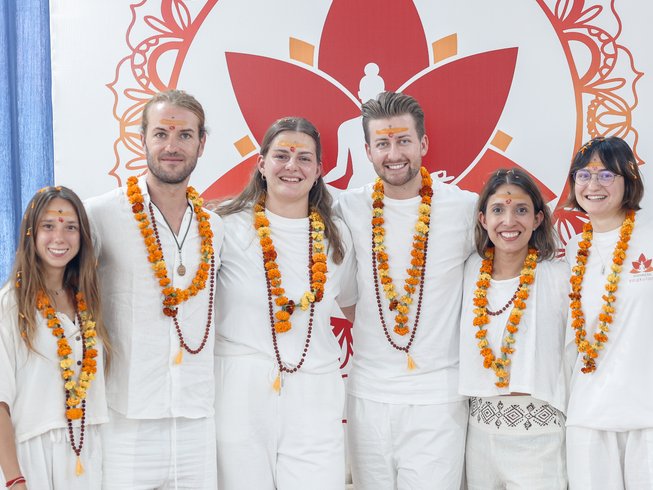
Born and brought up in Rishikesh, popularly known as the world capital of yoga. Amit is a young yoga practitioner and a learned yoga guru. His first formal training was at Jay Ram Ashram, Rishikesh, where he did an in-depth study on subjects like Hatha yoga, yoga philosophy, anatomy and physiology, yoga therapy, shatkarma, yogic diet, and nutrition, along with other aspects of art. Since then, Amit has dedicated himself to the path of yoga to gain proficiency in his work.

Mandeep Ji
Mandeep Ji is one of the popular yogis in Rishikesh. With his 10 years of yoga practice and teaching mantra chanting, yoga philosophy, and meditation, he has become an expert trainer of yoga. He has also worked as an astrologer for nine years. Mandeep Ji’s heart and soul lies in music and he says that music is life for him. He has practiced yoga and spirituality in Rishikesh for 18 years. Mandeep Ji is a yoga guru who has given a valuable part of his life to yoga and the preaching of meditation, sound healing, and the practice of yoga philosophy.
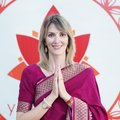
Ella Ji
Ella is specialized in Yin yoga, meditation techniques (especially Buddhist and Osho), pranayama, and Reiki. Her classes are focused to release the blockages from the body, both mental and physical. In her cueing, you can find many anatomical as well as psychological and spiritual aspects. She always puts great emphasis on breathing and meditation, both before and after the practice. She also likes to add some mantra chanting and aromatherapy. Her motto is to embrace the discomfort and allow changes to happen.

Jitu Ji
A distinguished and time-honored individual, Jitu Ji embodies traditionalism. He completed his Bachelor's in Sanskrit from Parmarth Niketan Ashram here in Rishikesh itself and went on to pursue his Master's in Yoga from the prestigious Uttarakhand Sanskrit University. He has spent over 10 years of his life in various ashrams like Bhagirathi Dham Ashram and Anand Dham Ashram. While he teaches Ashtanga Vinyasa at the school, his classical method of teaching brings students in, leaving them with a sense of gratitude and fulfillment.

Pankaj Ji
Pankaj Sharma was born and brought up in the foothills of Himalayas, Himachal Pradesh. After the completion of B.A in Sanskrit, he moved to Rishikesh and spent 8 years of his life in an ashram, learning yoga in the age-old Gurukul style leading a disciplined and yogic life. To Satiate his urge for knowledge Pankaj went on to pursue a Masters's degree in Yoga simultaneously teaching in various ashrams and Yoga schools. Due to his early induction to ashram life, Pankaj at a very young age has carved a niche for himself in yoga with his teaching skills and knowledge in Vedas, and Upanishads.
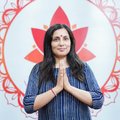
Deepa Ji
As a teacher, Deepa ji focuses largely on Meditation, Yoga Nidra, Mantra Chanting, and Laughing Yoga. She has fondly been teaching 200 hours and 300 hours of Yoga teacher training courses at various prestigious yoga schools for more than 12 years. For many, spirituality may have a definition differentiating from one another, but for Deepa ‘spirituality’ is all about peace of mind, being consistent within striking a perfect balance with yourself.
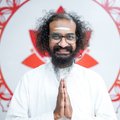
Sadhushri Ji
Sadhu Shri Ji has a deep knowledge in philosophy owing to his specialization in Indian Philosophy. He has studied Patanjali Yoga Sutra, Upanishads, and Buddhist literature in depth which has contributed immensely to his knowledge of philosophy and history. Now, for many years, the Yoga Guru has been sharing his valuable experience of philosophy with his students along with teaching his students on how to use the knowledge in day-to-day routine life with the help of practical approach backed by reasoning.

Siddha Ji
Siddha Ji brings a wealth of knowledge from his diverse experience and background.His yoga classes blend his love of creative ways of sharing this traditional knowledge with a modern aspect that connects the students deeply. With his continuous studies of different breathing practices (Pranayama), Sound Healing, Reiki and yoga as a modality to heal. There is a major focus on mindfulness, body and breathing awareness, Yoga Nidra, and various techniques of meditation as well as dipping into the more subtle aspects of yoga.
Retreat location
The school is situated in the heart of Rishikesh, next to the famous hanging bridge and the holy Ganga (the holy river). The school is peaceful and surrounded by beautiful green mountains. Everything is close by the school such as shops, cafes, restaurants, ATM, healthcare, and organic stores.

Unique features
Activities
- Shopping
General
- Air-conditioned rooms
- Dining area
- Kitchen
- Lobby
- Restaurant
- Smoke-free property
- Yoga shala
- Yoga studio
Services
- ATM / banking
- Convenience / grocery store
- Currency exchange
- Dry cleaning
- Free parking
- Free Wi-Fi
- Laundry
- Library
- Medical assistance
This Yoga Retreat is vegetarian-friendly
Click to see more vegetarian-friendly Yoga Retreats
Food
Everyday, Rishikesh Yogkulam will provide freshly made vegetarian meals as part of the program, with a focus on maintaining hygiene and utilizing organic vegetables. Rishikesh Yogkulam is renowned worldwide for its delectable and diverse cuisine. They firmly believe in the Ayurvedic proverb, "When diet is wrong, medicine is of no use. When diet is correct, medicine is of no need."
While many wonder if practicing yoga itself is sufficient, at Rishikesh Yogkulam, they emphasize that yoga is not just a practice but a way of life. When combined with healthy eating habits, the benefits can be truly transformative. Your food choices not only impact your physical well-being, but also your emotions and thoughts. In yoga, food is not classified based on proteins, carbohydrates, or fats, but rather on their effects on the body and mind: Satva, Rajas, and Tamas.
Tamasic food induces lethargy and sluggishness, while Rajasic food brings about restlessness Sattvic food, on the other hand, nourishes both the body and mind. It has a purifying effect, promoting clarity and calmness. Sattvic foods activate the body and mind, infusing them with energy and enthusiasm. Rishikesh Yogkulam considers cooked food consumed within 3 to 4 hours as Sattvic, aligning with its beneficial properties.
In addition to this, Rishikesh Yogkulam places great emphasis on maintaining high standards of hygiene within the institution. The aim is to ensure that the food they provide is not only safe but also possesses excellent nutritional value, which is essential for a healthy and fulfilling life. However, it is important to note that it is not just the selection of appropriate food that matters; consuming the right quantity of food at the appropriate times is equally crucial for optimal well-being.
Note: Rishikesh Yogkulam cannot cater for celiac disease or strong gluten allergy due to possible gluten contamination.
Note:
- In line with the yogic philosophy of respecting everyone's life, Rishikesh Yogkulam follow a lacto-vegetarian diet. They do also take care of dietary requirements such as dairy-free, gluten-free, vegan.
- Remember to let Rishikesh Yogkulam know before your arrival, if you follow a special diet or have a different allergy/intolerance then those mentioned above kindly let them know prior to your booking so they can check the possibility with the kitchen staff.
- Rishikesh Yogkulam cannot cater for celiac disease or strong gluten allergy due to possible gluten contamination.
- Rishikesh Yogkulam cannot guarantee no contamination for food.
- On Sundays, no food will be served and you can enjoy the meals in the cozy cafes nearby with beautiful Ganga view.
The following meals are included:
- Breakfast
- Lunch
- Dinner
- Drinks
The following drinks are included:
- Water
- Tea
- Detox juices
The following dietary requirement(s) are served and/or catered for:
- Vegetarian
- Gluten Free
- Organic
- Raw food
- Lactose Free
- Yogic
- Ayurvedic
Things to do (optional)
Outlined below are a selection of remarkable activities to engage in while in Rishikesh. Please note that these activities are not included in the package; however, Rishikesh Yogkulam can make the arrangement upon request.
- Ayurveda doctor consultation
- Ayurvedic massage and therapies
- Panchakarma treatment
- Sound Healing sessions and course level 1, 2, master
- Reiki sessions and course level 1, 2, master
- Astrology consultation with birth chart reading
- Physiotherapy session
What's included
- Daily yoga classes
- Daily meditation, pranayama, and chanting
- Daily Ayurveda classes
- Certificate of completion
- Ayurvedic massage
- 1 sightseeing tour
- Waterfall trekking tour
- White river rafting
- 3 fresh organic vegetarian meals
- 11 nights accommodation
- Complimentary pick-up from Jolly Grant Airport (DED) to the school
- Herbal teas
- Mala (Indian mantra necklace)
- Yogkulam course manual, yoga mats, 1 textbook, and pen
What's not included
- Airfare
- Personal expenses
- Drop off from the school to the airport
- A/C
- GST
How to get there
Recommended Airports
Transfer included
Jolly Grant Airport
15 km away from your destination
Transfer available for additional US$ 72 per person
Indira Gandhi International Airport
209 km away from your destination
Arrival by airplane
Please book your flight to arrive at Indira Gandhi International Airport (DEL), from where you can take a domestic flight to Dehradun Airport (DED). Upon your arrival, there is a complimentary taxi waiting for you, which will bring you from the airport to the yoga school at Laxman Jhula.
The check in time is between 10:00 a.m to 06:00 p.m IST.
Arrival by bus
From Indira Gandhi International Airport (DEL), you can get a taxi to bring you to Delhi ISBT bus station. From there, you can find many governments and private transportation to bring you to Rishikesh. Once you arrive at Rishikesh bus station, your complimentary pick up will be waiting for you to bring you to the yoga school at Laxman Jhula.
Arrival by train
The nearest railway station is the Haridwar train station. From there you will find many buses, taxis, and other transportation services that will bring you to Rishikesh. If you want Rishikesh Yogkulam to help you arrange transportation from Haridwar, kindly let them know.
Cancellation Policy
- A reservation requires a deposit of 20% of the total price.
- The deposit is non-refundable, if the booking is cancelled.
- The rest of the payment should be paid on arrival.

Reviews
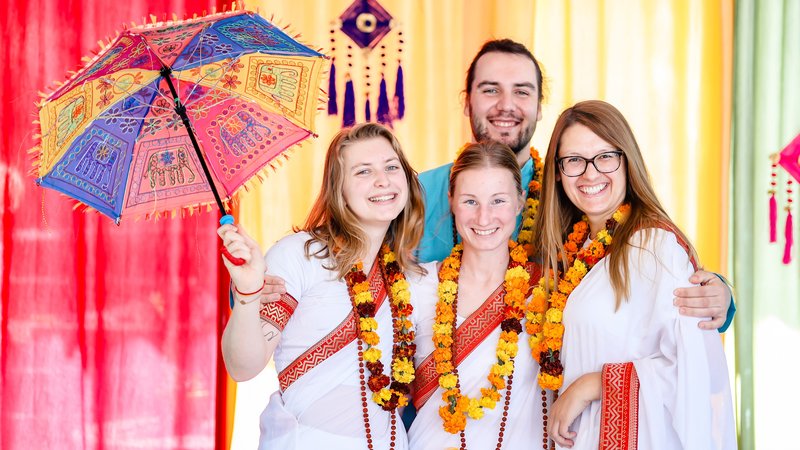
For this organizer you can guarantee your booking through BookYogaRetreats.com. All major credit cards supported.
Similar Yoga Retreats you might like
You recently viewed