
The listing is fully booked, get notified when dates are available
We’ll only ever send you one email notification and will never spam you
(No availability) 27 Day 200-Hour Nada Yoga Teacher Training in Rishikesh, India
Nada Yoga Teacher Training in India
Become a certified Nada yoga (the sacred sound) teacher and learn how to chant mantras with proper pronunciation, use mantras for meditation, lead kirtan and chanting circles, healing through mantras and raagas, and much more.
Meet the instructors
Read more
Highlights
- 2 yoga classes per day
- Daily guided pranayama and meditation sessions
- Mantra chanting and kirtan lessons
- Anatomy and philosophy
- Music concerts and excursions
- Eligible to register with Yoga Alliance upon completion
- 26 nights accommodation
- Daily meals
Skill level
- Beginner
- Intermediate
- Advanced
Yoga styles
26 days with instruction in English
Accommodation
Two students are accommodated in a shared, furnished double room with an attached bath (cold or hot water) and ceiling fans. Bed linen, a towel, and a door lock are provided; however, residents are responsible for those items as well as laundering their sheets and cleaning their room. Single occupancy arrangements may be made prior to arrival, conditional on room availability, and may be subject to extra charges. Students are requested to arrive at the Nada Yoga School on the day prior to the commencement of the training, at which time they will be assigned to their rooms and will be requested to finalize their course fee payments.
Check-out is scheduled on the morning following completion of the program. Nada Yoga School requests that all borrowed items be returned at this time. Note: To create a positive atmosphere conducive to learning and continued personal development, drugs, alcohol, and all other intoxicating substances are strictly prohibited for the entire duration of the course.
Program
Certification
Students who complete the training are eligible to register with Yoga Alliance as Registered Yoga Teachers (RYT®). On successful completion of the course, you will be certified as a Nada yoga teacher. After which, you can start guiding and healing others through the power of the sacred sound.
About the training
Nada yoga teacher training is a specialized program that focuses on the practice and teachings of Nada yoga. Nada yoga is the practice of yoga through sound and music. Nada yoga is the yoga of sound or the yoga of vibration, which explores the use of sound and music as a means of self-realization and spiritual development. Nada yoga teacher training programs are designed to provide a comprehensive understanding of this ancient practice and equip individuals with the skills and knowledge to teach Nada yoga to others.
During a Nada yoga teacher training program, participants learn about the philosophical and theoretical aspects of Nada yoga, as well as the practical techniques and methods for incorporating sound and music into their personal practice and teaching. Nada Yoga School is delighted to offer the most comprehensive and unique Nada yoga teacher training course in Rishikesh, India. If you ever wanted to learn about this sacred practice, then this is your chance. This course is suitable for yoga teachers, students (beginner, intermediate, and advanced), and music lovers who want to connect or integrate the enlightening power of sacred sound (nada yoga) with their daily practice of yoga, meditation, or healing.
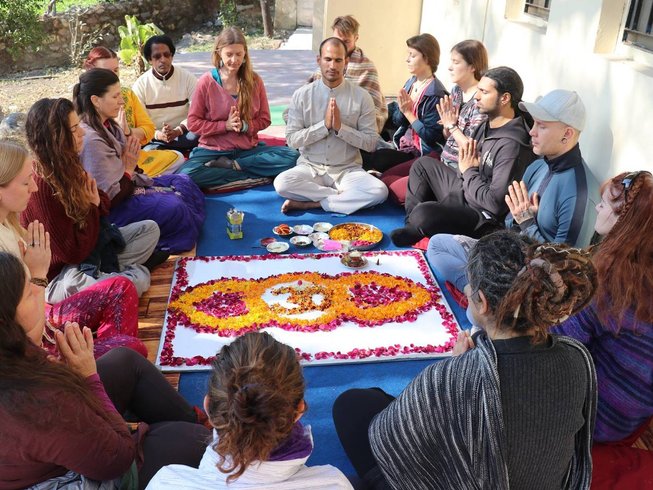
In this yoga teacher training, you will be immersed in the deep knowledge of Nada yoga, its path (branches), and its philosophy. The course will be taught by talented and notable yogis and remarkable yoga masters who have abundant experience in yoga and its many branches. Three to five hours of Nada yoga practice. You will be given daily homework assignments. A final written exam is taken at the end of the course. Indian classical music concerts, kirtans, and Bhajans every week. You will be taken for local sightseeing on Sundays.
What is Nada yoga?
Nada Yoga is a spiritual practice and a form of yoga that focuses on the use of sound and music as a means of attaining self-realization and spiritual enlightenment. “Nada” means “sound” or “vibration” in Sanskrit. In Nada Yoga, practitioners explore the power of sound vibrations to harmonize and purify the mind, body, and spirit. It is based on the belief that everything in the universe, including your own body, is made up of vibrations. By attuning oneself to the subtle vibrations of sound, one can achieve a deep state of meditation and union with the divine. The practice of Nada Yoga involves various techniques, including chanting, singing, listening to music, and focusing on internal sounds (such as the sound of one’s own breath or the heartbeat).
These techniques are used to cultivate awareness, concentration, and a heightened sense of inner sound. Nada yoga is closely related to the concept of “anahata nada,” which refers to the inner sound or “unstruck sound” that is said to resonate within the heart chakra. Practitioners aim to perceive and merge with this inner sound through their practice. The benefits of Nada yoga include increased mindfulness, relaxation, and a deeper connection to one’s inner self. It is believed to enhance mental clarity, balance emotions, and promote overall well-being. Nada yoga is a branch of yoga in which transformation is brought through the Shabd or Nada.
The nearest translation of Shabd and Nada is sound or vibration. But Shabd or Nada is not the same as sound because they can be produced either by striking two objects known as the Ahata sound or without striking two objects which are called the Anahata sound. Anahata sound can be heard at the Anahata or heart chakra. Nada has the same place in Yoga as energy has in science. You cannot see energy, but you can feel it as vibrations. All energy and all vibrations generate sound. Sound is one way for you to experience this energy.
Nada yoga
In this Nada yoga course, you will learn about Nada yoga (the sacred sound) and its origin. Types of Nada yoga. Is Nada yoga practical or just philosophy. How does it affect your body and mind? What is the connection between Nada yoga and Indian music? Mantras and Nada yoga. How to use Nada yoga for healing.
Sanskrit and mantra chanting
Mantra yokes the mind’s capacities to utilize it as a vehicle leading to higher intelligence. Mantras are said to have originated in the cosmic realm. Lore has it that the play of Shiva’s damru is the source of all sound, called Nada - the divine vibration. From this stream springs the Sanskrit alphabet. Each is a beej mantra that gives rise to further consonants. This course is designed to help you understand the Sanskrit alphabet (with Devanagari script), its phonetic significance for varied applications, and each letter’s beej mantra and their origins with different intonations and pitch are well elaborated and explained. You will learn the syllables of each mantra and the consonants with accuracy.
You will also learn how to chant each mantra in the correct pitch, continuity, and flow to the desired effect. The use of mantra is imperative for those who wish to deepen their knowledge and experience of the spirituality of measured sound. Mantras can be used as remedies for all types of life situations, rituals, and especially to deepen meditation. These mantras are also specifically used for healing therapies. Nada Yoga and mantra sadhana teach the sequence to deepen these practices of meditation through mantra to obtain desired results.
Kirtans and Bhajans
Kirtan is call and response devotional singing to the glory of the divine in various forms. Kirtan can take the form of repeating the name or the stories of the manifestations. Kirtan is done through the heart, feelings and emotions where devotion reigns supreme. It’s the straight and simple path in which no instructions or Guru is needed. Bhajan means “to chant or repeat.” Bhajan is any kind of devotional song that may come in a variety of forms ranging from classical raag to folk music. Bhajans are usually sung solo. Bhajans and kirtans forge emotional bond between the performer and the audience, making the art of performance a therapeutic and restorative experience.
Raagas And Indian Music
At its core, Indian music is spiritual, and nearly all of it can be used in Nada Yoga. Indian music originated in the chanting and singing of the Vedic mantras, particularly those from the Samveda. Later on, the evolution and growth of Indian music occurred in temples where it was used for prayer, worship and meditation. Indian classical music produces slow brain waves which help in the reduction of thought and encourage a state of deep tranquility, and clearly that was the reason for its use in spiritual practice. The primary aim of spiritual practice is to slow down the thought process, prevent the turbulent fluctuations of emotions and either bring the body to stillness or dance. The basic structure of Indian classical music is Raga. Raga means “to color the mind and the spirit”, leading both to a state of higher consciousness. Each raga is a unique combination of notes which works as formula or a sutra, carrying specific mood and energy, which then connects to nature in general, and to a specific state of consciousness. With practice, a musician experiences the essential core of the raga, contemplating and meditating upon it to unfold its essence and depth. This unfolding depends on each musician as ultimately the personality of the musician and the core of the raga merge, resulting in a spiritual experience. In this way, the act of playing a raga is an act of prayer, worship, and meditation, transporting the individual to higher consciousness in a vertical movement.
Nada yoga as music and sound therapy
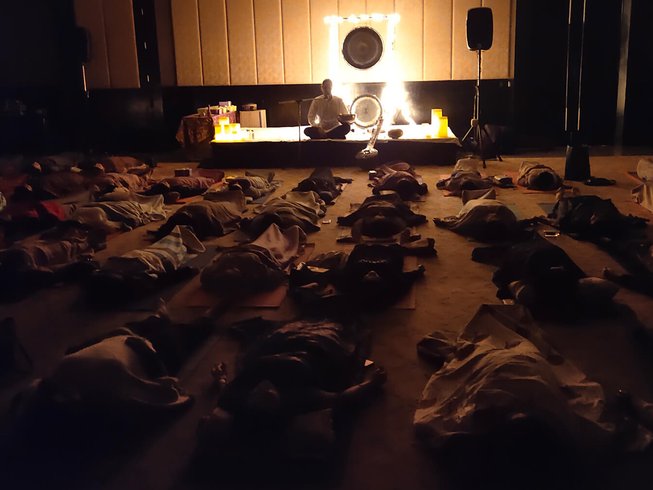
Nada yoga can be used as music therapy or sound healing, for the physical, psychological, and spiritual healing and well-being of a person or group. It is more effective than the current music and sound therapy because, in addition to the music component, it involves yoga poses, breathing techniques, meditations, and detoxification methods. In other words, it’s a holistic healing practice which includes body, emotions, and cognitive ability, and can be used as a preventive or curative measure. In terms of prevention, Nada Yoga is useful to relieve stress and create harmony between body and mind for the better balance or homeostasis of both. Nada Yoga can help in dealing with many chronic health problems including dementia and Parkinsonism. Nada Yoga can be active or receptive. Actively, in Nada yoga, a person creates vocal or instrumental music to express and heal. In receptive mode, the individual listens to sounds and music. Visualization, touch, body movement, and smell can be added to sound and music to enhance their effect on the brain and the body.
Introduction to Ayurveda
Ayurveda is an ancient vedic science that is closely related to the practice of yoga. Understanding of ayurvedic concepts will help you deepen the healing and compose diet and lifestyle that will suit your individual requirements. The lectures of Ayurveda will include the study of:
- Basics of Ayurveda (elements, dhatus, doshas, and tastes)
- Kapha, Vatta, and Pitta. Knowing your body type.
- Daily routine, seasonal routine, diet regimen, etc.
What you will learn
- What is Nada yoga?
- Origin of Nada yoga
- Types of Nada yoga
- Nada yoga meditation
- Learn Indian Raagas
- Healing through Indian Raagas
- Reading of Roman transliteration of Devanagari
- How to read and chant verses and mantras
- Vedic chanting and its rules
- Sanskrit alphabet, its sounds, and locations
- Accurate Sanskrit pronunciation
- What is a mantra
- Types of mantras
- Origin of Mantras
- Uses of mantra
- How to chant mantra (sagun, nirgun, vedic, lokik, tantrik & beej mantra)
- How to use the mantras for meditation and their sequence
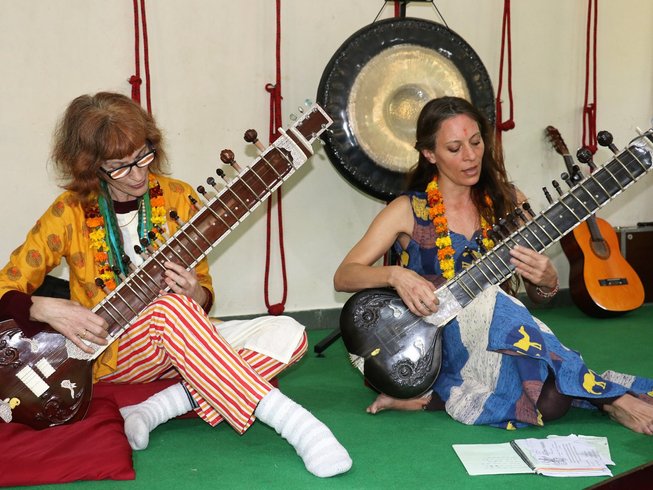
- How to play and lead Kirtans and Bhajans chants
- How to play kirtans and bhajans on harmonium or sitar
- How to use singing bowls for your teaching and practice
- Music therapy and sound healing
- How to match your body’s frequency to instruments sound
- Effect of sound or nada in your daily life
- Learn how to use everything you learn for teaching others and self-practice
Daily schedule
- 06:00 - 07:00 Pranayama, Shatkarma, or sound meditation
- 07:00 - 08:30 Yoga asanas
- 08:30 - 09:30 Breakfast
- 10:00 - 11:30 Music lessons, Mantras, or anatomy
- 12:00 - 13:00 Lunch
- 13:00 - 14:00 Nada yoga
- 14:00 - 15:30 Nada yoga philosophy
- 16:00 - 17:30 Self practice (music, Mantra, Q/A, etc.)
- 18:00 - 19:00 Meditation, live music meditation, mantra chanting, or kirtan
- 19:30 - 20:00 Dinner
Note: The schedule is subject to change.
Included excursions
- Local sightseeing (Sunrise at Kunjapuri Temple, Ganga Arti, etc.)
- Ganges River rafting
- Sunday movie night
Instructors
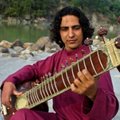
Yogacharya Bhuwan Chandra
As native of the greater Himalayas with a master degree in yoga from the Uttaranchal Sanskrit University, Bhuwan Chandra is a recognized professional Indian classical musician and Nada yogi. He has participated actively participated in yoga festivals, seminars, and music concerts all over India and abroad. Enriched by with this experience and having understood the intricate connection of between music and the body Chakra mechanism, he has created a holistic approach to yoga through the science of music (Nada), thus bringing a fresh approach to the yoga sequences.
Retreat location
The school is set in its prime location directly overlooking and alongside the beauty of the Ganges in the famous Ram Jhula area of Rishikesh.

This Yoga Retreat is vegetarian-friendly
Click to see more vegetarian-friendly Yoga Retreats
Food
You will be served daily healthy breakfast, lunch, and dinner included in the price. In their attempt to promote a yogic lifestyle, vegetarian meals and herbal teas are served three times daily and prepared in their own equipped kitchen, using filtered water. Please inform Nada Yoga School of any dietary restrictions. Filtered water is available at all times during your stay at Nada Yoga School.
The following meals are included:
- Breakfast
- Lunch
- Dinner
- Drinks
The following drinks are included:
- Water
- Tea
The following dietary requirement(s) are served and/or catered for:
- Vegetarian
- Yogic
What's included
- Training
- Lessons from 8 professional staff yoga teachers and guest lecturers
- Music concerts by renowned musicians of Rishikesh, India
- Local sightseeing (Sunrise at Kunjapuri Temple, Ganga Arti, etc.)
- Ganges River rafting
- Sunday movie night
- 26 nights comfortable accommodation
- 3 vegetarian meals per day
- Certificate of completion
- Access to a private Nada yoga community to support lifetime learning
- Textbooks and printed course materials
- Welcome kit (Jute bag, t-shirt, notebook, pen, neti pot, etc.)
- Use of props during the course (yoga mats, musical instruments, props, etc.)
- Wireless internet connectivity
What's not included
- Flights
- Airport transfers
- Any personal expense
How to get there
Recommended Airports
Transfer not provided
Jolly Grant Airport
14 km away from your destination
Transfer not provided
Indira Gandhi International Airport
208 km away from your destination
Cancellation Policy
- A reservation requires a deposit of 14% of the total price.
- The deposit is non-refundable, if the booking is cancelled.
- The rest of the payment should be paid on arrival.

You recently viewed