

Online 200-Hour Hatha, Vinyasa, Yin and Nidra Yoga Teacher Training With 30 Live Hours
Online Yoga Teacher Training
Now is a great opportunity for you to acquire an online yoga teacher certification from the Karuna Yoga Vidya Peetham. It is a yoga course with live sessions where you get a minimum of 30 days to a maximum of 3 months to complete. The course includes pre-recorded and lives yoga sessions on each topic of each subject with clear explanations and demonstrations from the teachers, and they work even with low connection. It’s completely a real learning experience from the Karuna Yoga Vidya Peetham to yourself. Join them today and be certified as a yoga teacher just from the comfort of your home!
Meet the instructors
Highlights
- 30 hours of live sessions
- 170 hours of yoga manual, study books, self-practiced and self-study
- Duration – 30 days to 3 months
- Live online sessions will be held over Zoom or Google Meet
- Online sessions’ time-zone: Bangalore, India (GMT+5:30)
- Daily one live yoga session theory or practical classes, Monday to Friday
- 200-hour yoga teacher training curriculum
- Eligible to register with Yoga Alliance upon completion
- Special discounts on advanced courses
- There will be live contact hours whenever needed in order to clarify doubts
- All classes are previously recorded so students can access the material at their own convenience
- One live Q&A session every week
- Topics include Hatha, yoga anatomy, yoga philosophy, meditation, and pranayama Yoga Nidra, and kinesiology
Skill level
- Beginner
- Intermediate
- Advanced
Yoga styles
30 days with instruction in English
Program
Pre-application requirements
This course is open to all students who wish to deepen their knowledge and application of some of the highest teachings of yoga. Participants do not need to be yoga teachers. Mastery of any yoga practice is not necessary. Only your sincere desire for knowledge and your commitment to personal growth. Even if you do not wish to be a yoga teacher, you may attempt this course to deepen the understanding of the philosophies as well as for the intense purification experience and for personality development. Classes start at the beginners' level and progress through to the intermediate level. Tools that you'll need for this training:
- Yoga mat
- Computer/smartphone with a camera
- Reliable internet connection
- Yoga blocks
- Pillow, bolster, or cushion
- Strap
- Notebook and pen
- Zoom
Certification
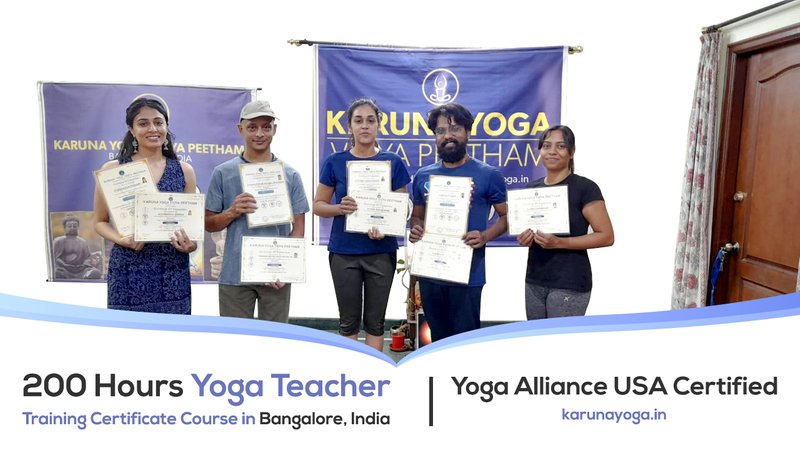
Students who complete their subsequent training are eligible to register with Yoga Alliance as Registered Yoga Teachers (RYT®) upon completion.
How the training works
Minimum time to complete this training is two months program and it can also be self-paced. All live sessions will be recorded for people who cannot join live sessions due to time differences. You can watch the recordings of live sessions at their convenience. Teachers will be available on Whatsapp to answer queries regarding postures, etc. At the end of the course, students are required to teach their batchmates on zoom (Karuna Yoga will arrange for that). There will be separate viva/exams for theory, anatomy, and philosophy.
Students will continuously be assessed throughout the course at all levels. There will be a practical as well as written examination at the end of the course to evaluate the understanding of the philosophy of yoga and the skills of the students. Participants should pass all different aspects of the course in order to receive a certificate of training completion. Assessment is based on:
- Regular attendance of all classes
- Attitude and behavior during the course
- Performance and attitude in the practical asana, pranayama, bandhas, and kriya classes
- Hatha yoga teaching skills
- Written daily summary of the main philosophy classes and Hatha yoga theory classes
Sample daily schedule from Monday to Friday (GMT+5:30)
- 06:00 - 07:00 Hatha yoga
- 07:00 - 08:00 Pranayama/anatomy
- 08:00 - 09:00 Vinyasa/teaching methodology/alignment/adjustment
Sample daily schedule from Saturday and Sunday (GMT+5:30)
- 10:00 - 13:30 Asana and yogic anatomy and physiology)
Kindly note that all online sessions will be conducted over Zoom.
Course information
During the course, you can expect well qualified and experienced instructors with their own specialties. You will receive adequate guidance to the individuals and groups during the training session. Yoga helps in self-discipline, leading to an immense amount of awareness, concentration, and a higher level of consciousness. This course will also help you to have a sound body and sound mind, along with proper yoga ethics.
Not only that, this yoga course helps you to learn how to handle oneself well in all situations, to learn techniques of gaining good health, to develop a discriminative mind capable of knowing the real from the unreal, and to face the dualities of life with equanimity. This course will increase the level of awareness and balance attitude for social activity.
At the end of the course not only you would have adopted a healthy lifestyle but you would also be fit to show others this path by becoming a skilled Yoga teacher. You will learn a unique combination of Hatha yoga, a, and Iyengar alignment principles. This approach has the ultimate goal of practicing injury free yoga.
Curiculum
The syllabus consists of Hatha yoga, asana, pranayama, mudra, bandha, yoga Nidra, kriyas, and meditation. This course also covers additional topics on Bhagavad Gita, Patanjali Yoga Sutra, yogic diet and nutrition, yoga philosophy and psychology, Hatha yoga-based anatomy and physiology, and Sanskrit.
Yoga styles
- Hatha yoga (B.K.S. Iyengar alignment principles and Satyananda style)
- Gentle yoga
Techniques training and practice
- Basic elements of asanas, pranayamas, mudras, and bandhas
- Three principles of practices, alignment, relaxed respiration, and consciousness
- Transitioning into asana - transitioning out of the asana
- Asana modification variations and the use of props
- Classical Surya Namaskara and Astanga Surya Namaskara
- Touch, somatic, and self-transformation (beginner to intermediate level)
- Standing forward bending - balancing and twisting asana
- Core strengthening asana, arm balancing asana, and backward bending asana
- Seated forward bending and twisting asanas
- Balancing asana - supine twists, backward bending, hip and pelvic opening asanas.
- Inverted asana
- Shoulder work, arm strengthening, arm balancing, rotation of arms and shoulders
- Pranayama - going deeper into the essence of breath
- Chakra balancing asana sequence
- Mantra meditation, chakra meditation, and breathe awareness
Teaching methodology
- Creating space for self-transformation
- Classroom set up and orientation
- Class levels and prerequisites
- Exploring clear and precise verbal expression
- Class etiquette
- Teaching styles and the varieties of approach
- Waking up the spiritual environment
- Techniques and tools in teaching yoga
- Application of modifications for individual needs
- Business approach
Yoga, anatomy, and physiology
- Pranas, upa-pranas, chakras, nadis, and granthis
- Pancha kosha (five-layer of existence)
- Introduction to human anatomy and physiology
- Cardiovascular and nervous system
- Respiratory system, musculoskeletal system, and spinal cord
- Yoga and spine
- Structure and function of the spine
- Types and functions of bone
- Skeletal system and asana
- Physiology of stretching during asana practice
- How to stretch safely with their individual limitation
- Biomechanics of stretching
- Kinesiology: to understand the different movements of the human body at minor and major joints levels
Yoga philosophy, lifestyle, ethics, health, and wellness
- Karma yoga, Bhakti yoga, Jnana yoga, and Raja yoga
- Vedas, Katha Upanishad, Taittiriya Upanisad, and Mandukya Upanisad
- The Bhagavad Gita (selected chapter)
- Patanjali Yoga Sutras (selected sutra)
- Yogic diet and nutrition
- Ethics: dharma, artha, kama, moksa. Brahmacharya, grihastha, vanprastha, and sanyasa ashrama
- Health, wellness, and lifestyle
Practicum
- Practice asana, pranayama, mudras, kriyas, and bandhas
- Practice the basics of assisting and adjusting
- Methodology of asana, contraindications, and benefits
- Observing other's teaching and receiving/giving feedback
Elective
- Vinyasa yoga
- Gentle yoga
- Restorative yoga
Project writing
- Project writing of 50 to 100 pages
Tutorials, assignments, and examination
Trainee will be required to engage in self-study and submit daily and weekly assignments on the basis of the day's lectures and discussions. There will be a practical and a theory exam at the end of the course to assess the students on their learning, practice, and teaching during the teacher training course.
Paper - 1 Training and Practice
1. Yoga Mantra Chanting
- Introduction
- Mantras
- Gayathri Mantra
- Maha Mrityunjaya Mantra
- Saha nāv avatu
- Sarve bhavantu sukhinaḥ
- Patanjali Mantra
- 6. Surya Namaskara Mantra
2. Surya Namaskara (sun salutation)
- Introduction
- Preparation
- General contra-indications
- General benefits
- Time of practice
- Awareness
- Conclusion
- Duration
- Beeja mantras
2.1. Sivananda - Surya Namaskar (sun salutation)
2.2. Chandra Namaskara (salutations to the moon)
2.3. Astanga Surya Namaskara - A
2.4. Astanga Surya Namaskara-B
2.5. Foundation of Asana
- Hatha Yoga View on Asana
- Patanjali concept on Asana
- Classification of Asana
- Beginners
- Intermediate
- Advanced
- Isometric static & Dynamic Asana
- Dynamic practices
- Static practices
- Perspective view on Asana
3. Asanas
3.1. Standing Asana Beginners Level
- Samasthiti(upright or still)
- Tadasana – (mountain pose)
- Vrksasana (tree pose)
- Ardha Uttanasana(standing half forward bend)
- Padahastasana (hand to foot pose)
- Ardha Chakrasana (half wheel pose)
- Garudasana (eagle pose)
- Utkatasana (mighty pose)
- Utthita Trikonasana (extended triangle pose)
- Parivritta Trikonasana (revolved triangle pose)
- Utthita Parsvakonasana (extended side angle pose)
- Parivritta Utthita Parsvakonasana (revolved extended side angle pose)
- Parsvottanasana(side intense stretch)
- Virabhadrasana -1 (warrior -1)
- Virabhadrasana -2(warrior-2)
- Ardha Chandrasana (half moon pose)
- Virabhadrasana -3(warrior-3)
- Natarajasana(Lord of the dance Pose)
- Prasarita Padottanasana(legs widespread intense stretch)
- Utthita Hasta Padangusthasana(intense arms hold big toe)
- Malasana (garland pose)
- Vajrasana (diamond pose)
- Balasana(Child’s Pose) or Shashankasana ( moon or hare pose)
- Madukasana(Frog Pose) or Bhadrasana (gracious pose)
- Marjaryasana(Cat Pose)
- Vyaghrasana(Tiger Pose)
- Virasana (hero pose)
- Ustrasana(camel pose)
- Supta Virasana (recline hero pose)
3.2. Sitting Asana Beginners Level
- Sukhasana(Easy pose)
- Dandasana (Staff Pose)
- Siddhasana(adept pose)
- Padmasana(lotus pose)
- Janu Sirsasana (Head to Knee Pose)
- Parivrtta Janu Sirsasana(revolved knee to head pose)
- Paschimottanasana(ugrasana or brahmacharyasana)
- Purvauttansana(east intense stretch pose)
- Gomukhasana(cow face resembling)
- Marichyasana(name of the sage mariachi)
- Ardha Navasana (half boat)
- Upavistha Konasana(wide angle seated forward bend pose)
- Baddha Konasana(bounded angle pose)
- Ardha Matsyendrasana (half spinal twist)
- Yogamudrasana(yoga gesture or psychic union pose)
- Ardha Padma Paschimottanasana(half lotus west intense stretch pose)
- Ardha Baddha Padma Paschimottanasana(half bounded lotus west intense stretch pose)
- Bharadvajasana(Bharadvaja was the father of drona)
- Hanumanasana(front full split or hindu monkey god)
- Eka Pada Raja kapotasana(single leg king pigeon pose)
- Shavasana(corpse pose)
- Supta Pawanmuktasana (wind relieving pose)
- Setu Bandha Sarvangasana(bridge lock Sarvangasana)
- Jathara Parivartanasana(abdomen twisting pose)
- Salamba Sarvangasana(supported Sarvangasana)
- Matsyasana(fish pose)
- Supta Konasana(reclining angle pose)
- Urdhva Cakrasana(upward wheel pose)
- Niralamba Sarvangasana (without support Sarvangasana)
- Supta Padangusthasana(supine holding big toe)
- Halasana(Plough Pose)
- Eka Pada Urdhva Dhanurasana(single leg upward bow pose)
3. 3. Prone Asana (abdomen) Beginners Level
- Makarasana (crocodile pose)
- Ardha Shalabhasana(half locust pose)
- Salabhasana (locust Pose)
- Sarpasana(snake pose)
- Bhujangasana(serpent pose)
- Ardha Dhanurasana (half bow)
- Dhanurasana(bow pose)
- Urdhva Mukha Svanasana(upward facing dog pose)
- Parsva Dhanurasana(sideways bow pose)
3. 4. Arm Balancing and Head Standing Asana Intermediate Level
- Phalakasana(plank pose) or Santolanasana (balancing pose)
- Chaturanga Dandasana(four limbed staff pose)
- Tolasana(scale pose)
- Purvottanasana(east intense stretch)
- Mayurasana (mayura means a peacock)
- Salamba Sirsasana
4. Pranayama
- Introduction
- Four aspects of pranayama
- The Pranic body
- Breath, health and pranayama
- Breathing and life span
- General notes for the practitioner
- Contra-indications
- Time of practice
- Bathing
- Clothes
- Empty stomach
- Diet
- Place of practice
- Breathing
- Sequence
- Sitting position
- Avoid strain
- Side effects
- Natural breathing
- Abdominal Breathing
- Thoracic Breathing
- Clavicular Breathing
- Full Yogic Breathing
- Kapalbhati Pranayama (frontal brain cleansing breath)
- Bhastrika Pranayama (bellows breath)
- Nadi Shodhana Pranayama (psychic network purification)
- Ujjayi Pranayama (the psychic breath)
- Sheetali Pranayama(cooling pranayama)
- Sheetkari Pranayama (hissing breath)
- Bhramari Pranayama (humming bee breath)
5. Mudra
- Mudras and prana
- A scientific look at mudras
- Mudras
- Jnana mudra
- Chin mudra
- Bhairava mudra
- Hridaya mudra.
- Shambhavi mudra
- Nasikagra drishti
- Shanmukhi mudra
- Yoga mudra
6. Bandhas (neuro-muscular locks)
- Introduction to Bandha
- Granthis
- Bandha (lock)
- Jalandhara Bandha (throat lock)
- Moola Bandha (perineum contraction)
- Uddiyana Bandha (abdominal contraction)
- Maha Bandha (the great lock)
7. Yoga Nidra
- Introduction
- Yoga Nidra steps
- Preparation/Introduction
- Relaxation
- Sankalpa/Resolve
- Rotation of Consciousness
- Breathe Awareness
- Feeling of Sensations
- Image visualization
- Sankalpa/Resolve
- Finish
8. Dhyana (Meditation)
- Meditation on Breath (Anapana)
- Part 1: Observation of the natural breath
- Part 2: Observation of the sensations
- Observe without reacting and keep the equanimity
- Meditation Room
- Brahmamuhurta
- Asana
- Direction
- Where to Concentrate
- Fixed Hours
- Definite Place
- A Steady Pose
- Face the North or East
- A Seat
- Repeat Elevated Prayer
- Clear Articulation
- Vigilance and Alert Attitude
- Yogic Diet
9. Shatkarma (internal cleansing)
- Jala Neti (nasal cleansing with water)
- Sutra Neti (nasal cleansing with thread)
- Vaman Dhauti (regurgitative cleansing)
- Shankhaprakshalana (cleansing entire digestive tract)
10. Asana Benefits and Limitations
2. Teaching Methodology
- Introduction
- Trend of Teaching
- Methodology
- Need of Yoga Teaching Method
- Importance of Teaching Method:
- Classroom Setup and Orientation
- Voice and Language
- Querying new students
- Ethics in Teaching and Touching
- Practice Teaching Observation
- Marketing a Yoga Business
- Introduction
- Yoga Marketing Plan: Who Is Your Target Audience?
- Yoga Teacher Marketing: Choose Your Niche
- Marketing for Yoga Instructors: Decide On A Name & Logo
- Yoga Social Media Marketing
- Research the Competition
- Using Hashtags to Do Competitor Research
- Using Captions & Hashtags to Improve Reach
- Choose a Good Caption
- Using Localized Hashtags
- Interact with Similar Accounts
- How Do Interactions Help Your Yoga Instagram Marketing Strategy?
- Yoga Social Media Marketing: Be Consistent
- Follow the 80-20 Rule
- Yoga Social Media Marketing: Collaborate!
- Yoga Advertising Ideas: Paid Ads on Facebook and Instagram
- Online Workshops & Webinars
- Yoga Marketing Website: Why You Need One
- Google My Business for Yoga Teacher Marketing
- SEO & Content Marketing Tips for Your Yoga Business
- Yoga Studio Marketing Ideas: Start a Blog!
- Yoga Advertising Ideas: Paid Google Ads
- How to Use Email Marketing for A Yoga Business
- Once you’ve built an email list, what now?
- Marketing a Yoga Business Offline
- The class experience results into ‘word of mouth’ marketing
Paper: Techniques
- General Principles of Yogic Practices
- Asana Laboratory Observation
- Transitioning into Asanas
- Transitioning out of Asanas
- Seven Principles of Hands on Adjustments
- Principle 1: Teach What You Know
- Principle 2: Ask Permission to Touch
- Principle 3: Have Clear Intention
- Principle 4: Move with the Breath
- Principle 5: Honor Safe Biomechanics
- Principle 6: Teach Essential Asana Elements
- Principle 7: Support Stable Foundations
- Sthiti (initial) and Sithila (relaxation) postures for all asanas
- Method of Asana teaching
- Basic Arc Structure of Classes
- Initiating the Yogic Process
- Warming the Body
- Pathway to the Peak
- Exploring the Peak
- Integration
- Principles of Sequencing Asana
- Applied Parinamavada(theory of transformation)
- Move from Simple to Complex Asanas
- Move from Dynamic to Static Exploration
- Sattvic Effect: Cultivating Energetic Balance
- Pratikriyasana(counter pose)
- Student Daily Self - Assessment
Paper - 3 Yoga, Anatomy and Physiology
1. Introduction
- Need Anatomy and Physiology in Yoga
- Anatomy
- Physiology
- Anatomy
- Physiology
- Anatomical Terminology
- Directional terms
- Movement Definitions
- The six basic movements of the body place in three planes.
- Coronal plane:
- Sagittal plane
- Transverse plane
- Body Cavities
- Thoracic cavity
- Abdominal and pelvic cavity
- Dorsal cavity
- Chemical to Organism level
- Different Systems of the Body
2. Respiratory system
- Gaseous Exchange
- Respiratory System
- Larynx
- Trachea (wind pipe)
- Bronchi
- Bronchioles
- Alveoli (Air sacs)
- Lungs
- Pleura
- External Anatomy
- Bronchi
- Pulmonary Ventilation:
- Respiration Mechanism
- Normal breathing involves several different mechanisms.
- Shallow breathing
- Deep Breathing
- Unconscious control of breathing
- Conscious control of breathing
- Lung Volume
- Total air volume
- Tidal volume
- Vital capacity
3. Muscular System and Yoga
- Characteristics of Skeletal Muscles
- Functions of Muscles:
- Muscular tissues can be classified
- Smooth, non-striated or involuntary muscles.
- Cardiac muscle or myocardium.
- Skeletal, striated or voluntary muscles.
- Gross Anatomy of Skeletal Muscles
- Types of Muscle Contractions
- Isometric Contraction
- Isotonic Contraction
- Concentric Contraction
- Eccentric Contraction
- Muscle fiber types
- Muscle fiber types
- Slow twitch muscle fibre (type -1)
- Aerobic exercise
- Fast twitch muscle fibre (type -2)
- Anaerobic exercise
4. Skeletal System
- Skeleton
- Skeletal muscle
- Joint
- Cartilage
- Tendon
- Ligament
- Fascia
- Bursa
- Types of bone and cartilage
- Functions of the Skeletal System?
- The main bones of the human skeleton are
- The axial skeleton
- The appendicular skeleton
- Classification of Bones according to shape
- Long bones
- Short bones
- Flat bones
- Irregular bones
- Sesamoid bones
- Skeleton Joints
- Fibrous joints
- Cartilaginous joints
- Synovial joint
- Synovial joints
- Synovial joints classifications
- Hinge
- Ball and socket
- Pivot
- Gliding
- Saddle
- Planar
5. Kinesiology
- Biomechanics and Kinesiology
- Body Movements
- Body Movements and Their Descriptions:
- Flexion
- Extension
- Abduction
- Adduction
- Supination
- Pronation
- Lateral flexion
- Rotation
- Medial rotation (internal rotation)
- Lateral rotation (external rotation)
- Elevation
- Depression
- Dorsiflexion
- Plantar flexion
- Eversion
- Inversion
- Protraction
- Retraction
- Circumduction
5.1. Asana and Kinesiology
Paper - 4 Yoga Philosophy, Lifestyle and Ethics
- Introduction
- Shad-Darsanas (Six Systems of Indian Philosophical Thought)
- Goal of the Shad-Darsanas
- Meaning
- Definition of Yoga
- Yoga Vasishta
- Bhagvat Gita
- Bhagvat Gita
- Kathopanisad
- Swami Vivekananda
- Sri Aurobindo
- History of Yoga
- Pre-Vedic period (Before 3000 BC)
- Vedic period (3000 BC to 800 BC)
- Pre classical (Upanishad) period (800 BC to 250 BC)
- Classical period (184 BC to 148 BC)
- Hatha Yoga
- Introduction
- Meaning of Hatha Yoga
- Asana and Hatha Yoga
- Pranayama and Hatha Yoga
- Gurushishya Parampara
- Guru Shishya Tradition in Yoga
- Teaching Tradition
- What is Satyananda Yoga?
- Satyananda Yoga involves the practice of:
- Iyengar Yoga
- The Gist: From the Known to the Unknown
- Iyengar Alignment: The Practice of Precision
- Ashtanga Vinyasa Yoga
- Nadis
- Ida, Pingala, Shushmna
- Chakras (Energy Vortex)
- Mooladhara cakra
- Svadhisthana cakra
- Manipura cakra
- Anahata cakra
- Visuddhi cakra
- Ajna cakra
- Bindu
- Sahasrara cakra
- Purusharthas Four attainments of life
- Dharma (Virtue)
- Artha (Wealth)
- Kama (Pleasure)
- Moksha (Emancipation)
- Four stages of Life
- Brahmacharya Ashram
- Grihastha Ashrama
- Vanprastha Ashrama
- Sanyasa Ashrama
- Gunas
- Sattvic Guna
- Rajasic Guna
- Tamasic Guna
- Karma Yoga (path of selfless action)
- Types of Karma
- Sanchita Karma or Stored Karma
- Agami Karma or Forthcoming Karma
- Prarabdha or Vartamana Karma or Present Karma
- Jnana Yoga (path of knowledge)
- Meaning
- Jnana yoga consists of seven parts:
- Raja Yoga (path of royal yoga)
- Aim of Raja Yoga
- Practice (abhyasa) and dispassion (vairagya)
- Astanga Yoga(eight limbs of yoga)
- yama- social ethical code
- niyama- personal ethical code
- Path of Devotion (Bhakti Yoga)
- Sravana
- Kirtana
- Smarana
- Padasevana
- Archana
- Vandana
- Dasya
- Sakhya
- Atma-Nivedana
- Upanisad(essence of knowledge)
- Mandukya Upanisad
- Waking – Vaishvanara
- Dreaming - Taijasa
- Deep Sleep – Prajna
- Beyond this three - Turiya
- Taittiriya Upanisad
- Annamaya kosha - food sheath
- Pranamaya kosha - breath sheath
- Manomaya kosha - mind sheath
- Vijnanamaya kosha - intellect sheath
- Anandamaya kosha - bliss sheath
Paper - 5 Practicum
Part -1
- Name of Pose in Sanskrit
- Name of Pose in English
- Benefits
- Contraindications
Part - 2
- Sthiti (initial)
- Transition In with breathing and awareness
- Final Pose reflection and refinement
- Stability
- Comfortability
- Alignment
- Active muscles and relaxed mind, with soft breathing)
- Transition Out with breathing and awareness
- Sithila (relaxation)
Part - 3
- Counter Pose
- Modifications
- Alignment cues
Part - 4
- Trainee should observe following elements in classes, under the guidance of lead trainee
Part - 5
- Trainee should take following yoga classes, under the guidance of lead trainer
Paper - 6
- Tutorials, Assignment and Examination
Paper - 7
- Project Writing
Instructors

Dr . S. Karuna Murthy
Dr. Karuna served as a yoga therapist at S-VYASA, Bangalore, as a yoga lecturer at Bharathidasan University, and overseas as a yoga instructor at Cali wow fitness center. Dr. S. Karuna Murthy has completed an M.Sc in Yoga from Swami Vivekananda Yoga Anusandhana Samasthana University and Ph. D from Bharathidasan University, also 200-hour teacher training course, and 500-hour advanced teacher training course, and to registered E-RYT-500 with Yoga Alliance (USA), which reflects his in-depth knowledge and expertise in the context of yoga.
Suhas
Teaching Hatha yoga for over five years, Yogi Suhas has earned a good name in motivating students with the utmost professionalism. He helps students gain an understanding of body alignment and asana. His passion for yoga is visible in the classes he takes; students find his classes highly effective. Yoga has been a part of his life since his childhood. Yogi Suhas helps students plunge into what he has been teaching with enthusiasm and an open mind. Suhas has completed a Graduation degree in Commerce and 200 hrs Yoga Teacher Training from Karuna Yoga Vidya Peetham, Bangalore, India.
Retreat location
This teacher training is held online. Karuna Yoga Vidya Peetham is located in Karnataka, India (GMT+5:30), and they will live-stream yoga classes via Zoom which you can participate from the comfort of your home.

What's included
- 30-hour online yoga teacher training
- 170-hours online contact hours
- 160 non-contact hours
- All online training
- Support during the course
What's not included
- Accommodation
- Food
How to get there
Recommended Airports
Transfer not provided
Kempegowda International Airport
28 km away from your destination
Cancellation Policy
- A reservation requires a deposit of 100% of the total price.
- The deposit is non-refundable, if the booking is cancelled.

Reviews
No reviews yet
For this organizer you can guarantee your booking through BookYogaRetreats.com. All major credit cards supported.